
Audience research
Part of Desk data or real people for keyword research audience research?
Why keyword research survey tools hinge on panel access, not subscriptions
Compare keyword research survey tools for England teams: panel samples, DIY forms and hybrid stacks, with costs, compliance points and a worked example.
What to take away
- Keyword research survey tools split into panel suites, DIY form builders and hybrid stacks. The subscription is rarely the main cost. Panel access and question design drive usable answers.
- Qualtrics, SurveyMonkey, Pollfish and Prolific supply respondents directly or sell completes. Semrush supplies market data instead. Google Forms, Typeform and SmartSurvey leave recruitment to you.
- Under UK GDPR, any tool storing respondent data needs a lawful basis and a retention rule you can explain.
- The worked example below shows an illustrative £940 a month for a small content team. A recruiter-led route can cost £1,200 for 40 category buyers.
Which keyword research survey tools give you panel access
Survey panels and market data suites
These platforms pair a survey builder with a respondent panel. You field questions on search behaviour and buying intent without recruiting participants.
Semrush is a market and competitor data suite. Its Analyse your market competitors tools size a market before you write content, but the subscription supplies no respondent panel.
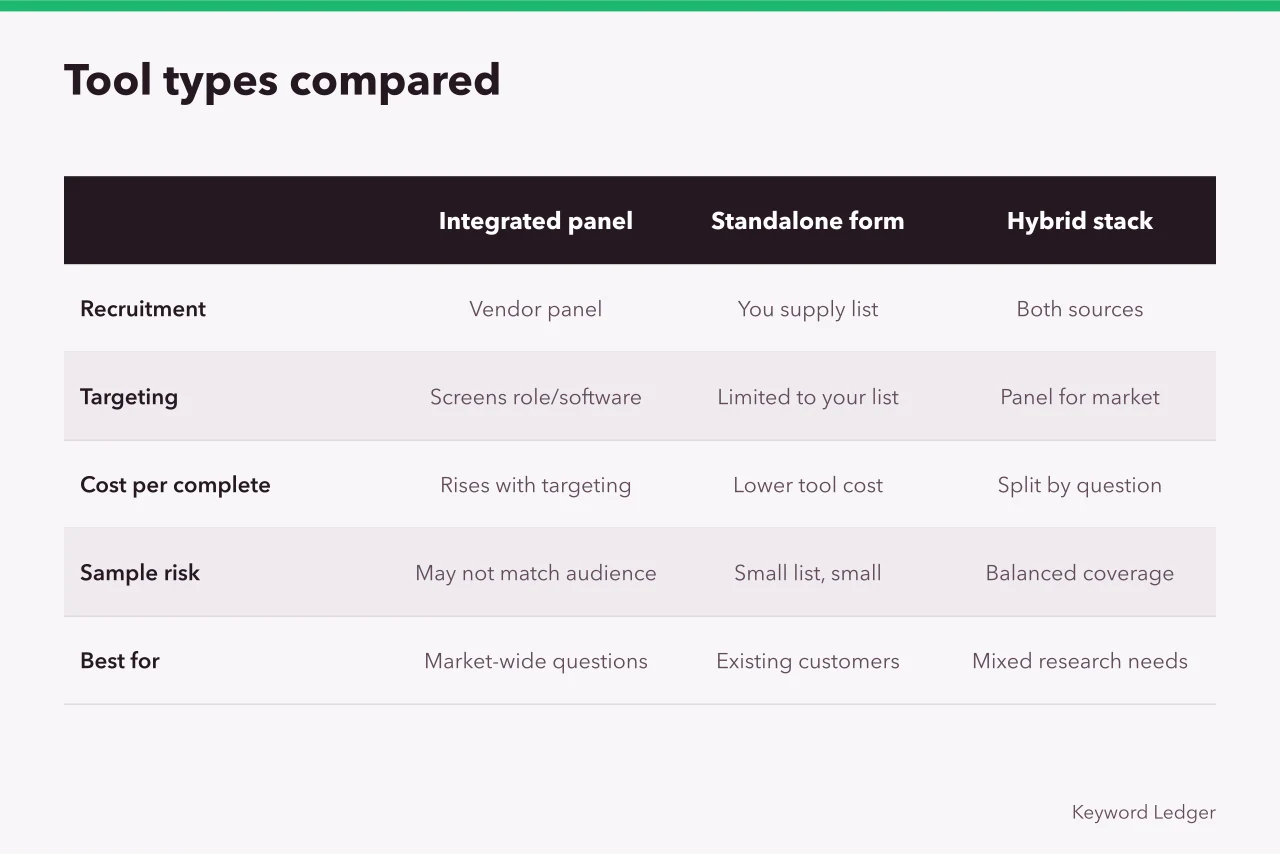
Panel respondents answer quickly, but you rarely know whether they match your target audience. For content planning, 50 answers from category buyers beat 500 from the general public.
Cost rises with targeting. A panel that screens for job role or software use charges more per complete, because the vendor must screen out far more people to find them. An England-only quota narrows the pool, so the price per usable answer rises further.
Qualtrics, SurveyMonkey Audience, Pollfish and Prolific offer panel access. YouGov, Toluna, Cint and Dynata do too.
No panel suite is built only for keyword research. The workable pattern is a panel that screens on buying behaviour, such as Prolific, Pollfish or SurveyMonkey Audience, plus a form builder for questions you write yourself.
Qualtrics, YouGov, Toluna, Cint and Dynata publish no rate card, so each price arrives as a project quote set by incidence, quota size, survey length and whether you need recontact.
Pollfish sells self-serve completes, typically from around £0.50 to £5 each as of 2026. Prolific, a UK company, pays participants and charges researchers a platform fee, with rewards typically around £9 to £12 an hour. SurveyMonkey Audience adds panel orders to paid plans that typically start around £25 a month.
For England-only recruitment, the Market Research Society's Company Partner directory lists UK research agencies and is free to search. Those agencies quote per recruited participant rather than per complete.
| Tool | Type | Panel access | England targeting | Typical cost |
|---|---|---|---|---|
| Semrush | Market and competitor data suite | No, supplies no respondents | Country-level keyword and competitor data | Plans typically from around £100 a month; no fieldwork included |
| Qualtrics | Survey platform | Yes, via partner panels | Yes, custom quotas | Project quote, no public rate card |
| SurveyMonkey | Builder plus Audience panel | Yes, Audience panel | Yes, country and demographics | Free tier; paid plans typically £25 to £99 a month; panel per complete |
| Pollfish | Self-serve mobile panel | Yes | Yes, country, age, gender, some behaviours | Typical £0.50 to £5 per complete |
| Prolific | Research participant pool | Yes | Yes, country and prescreeners | Participant reward plus platform fee, typically around £9 to £12 an hour plus fee |
| YouGov | Panel and research | Yes | Yes, UK panel | Project quote, no public rate card; UK panellists paid per survey |
| Toluna | Panel and survey platform | Yes | Yes, country targeting | Project quote, no public rate card |
| Cint | Programmatic panel exchange | Yes | Yes | Per complete, no public rate card |
| Dynata | Panel and data | Yes | Yes | Project quote, no public rate card |
| Google Forms | Form builder | No | No native panel | Free |
| Microsoft Forms | Form builder | No | No native panel | Included with Microsoft 365, typically from around £5 per user a month |
| Typeform | Form builder | No | No native panel | Free tier; paid plans typically from around £25 a month |
| SmartSurvey | UK form builder | No | No native panel | Free tier; paid from around £20 a month |
Standalone survey and form builders
Form builders cost less and give you control over question wording. The catch is recruitment: you supply the email list or customer database. If your list is small, your sample is small. Small samples produce keyword themes that look precise but are not.
Google Forms is free with a Google account. Microsoft Forms comes with Microsoft 365 plans, typically from around £5 per user a month. Typeform and SmartSurvey have free tiers, with paid plans typically from around £20 to £25 a month. None of these recruit respondents for you.
Watch for leading questions. 'How useful is search?' invites agreement. 'Which sources do you check before buying?' returns terms you can code into keyword groups.
A middle path is a form builder for existing customers and a panel tool for market-wide questions. The audience research guide for England covers sampling frames and question design in more depth.
What it costs and what the rules require
A worked monthly example
An illustrative example: a team pays £400 a month for a panel suite with 2,000 responses included, plus £120 for a form builder. A freelance analyst coding open answers costs £300. A data protection review adds £120. The monthly total is £940. These figures are illustrative, not vendor quotes.
Illustrative monthly costs
- £400Panel suite with 2,000 responses
- £120Form builder subscription
- £300Freelance analyst coding answers
- £120Data protection review
Coding turns open answers into keyword groups. Illustrative answers to 'How did you choose your last coffee machine?' fall into four groups: price and model, quiet operation, where to buy, and upkeep such as descaling. Each group becomes a content brief.
The same team could spend nothing on tools and £1,200 on a recruiter who finds 40 category buyers. That route often suits keyword research better, because answers come from people whose search behaviour you are modelling.
Compliance and data handling
UK GDPR requires a lawful basis for processing respondent data and a retention period you can defend. Write both down before you sign a data processing agreement. Record the basis in your research plan as well as the contract.
Keep demographic questions to what you will use. Delete raw responses once coded. That reduces risk and makes the research repeatable.
How to compare tools before you commit
Match the tool to the decision
Write down the decision the survey will inform. For choosing content themes you need open-text answers you can code into keyword groups. For choosing which competitor to watch, you need market data more than opinions. Competitive research educational resources from Moz explain how to frame that question.
Check whether the tool exports raw responses rather than only showing dashboards. Shortlist two tools at most. Field the same five questions in both and compare the coding effort.
Compare coding effort the same way you compare price. Code 20 answers from each tool into keyword groups and note any manual step, such as splitting one text column, that you would repeat on every survey.
Check the sample before the price
Ask how respondents are recruited and whether you can target by region, job role or purchase history. A tool that cannot target England-only respondents wastes budget on a region-specific content plan. The method in keyword research target audience in England shows how to define a regional sample.
For England-only theme discovery, treat 20 to 50 responses as the minimum viable sample.
Run a pilot of 20 responses before buying an annual licence. It reveals question problems, coding effort and true cost per usable answer.
Common questions
Do I need a panel survey to do keyword research?
No. Many teams start with interviews, search console analysis and competitor research, then use a survey to confirm a hypothesis. Panels help most when you need a defensible number for a market or audience size.
How many survey responses are enough?
It depends on the decision. For theme discovery, 20 to 50 well-chosen responses can be enough. For claims about a population, size the sample to the margin of error you accept. Statista's forecast of generative AI users shows how demand estimates vary with method and date.
What should I check in a data processing agreement?
Look for the retention period, sub-processor list, breach notification timescale and whether the vendor uses respondent data for its own purposes. If any of those are vague, ask for written clarification before signing.