

Strategy
Part of How do you build a keyword research strategy in three workstreams?
Build a keyword research ninety day plan that survives contact with the business
Plan ninety days of keyword research around one decision: scope the data, weigh the evidence, map terms to pages and agree a stop list before publishing.
What to take away
- You are choosing which decisions the plan must settle in ninety days: which audiences to serve, which pages to build first, and which work you will refuse.
- Three phases workweeks 1 to 3 for scope, weeks 4 to 9 for evidence and mapping, weeks 10 to 13 for sign-off.
- Budget tooling and people separately, so a licence renewal does not quietly consume the research time you promised.
Which decision does the plan have to settle?
Start with the decision, not the keyword list. A ninety day plan is a delivery mechanism, so write down what changes when it ends: a content queue for one product line, or an answer on whether a market is worth entering.
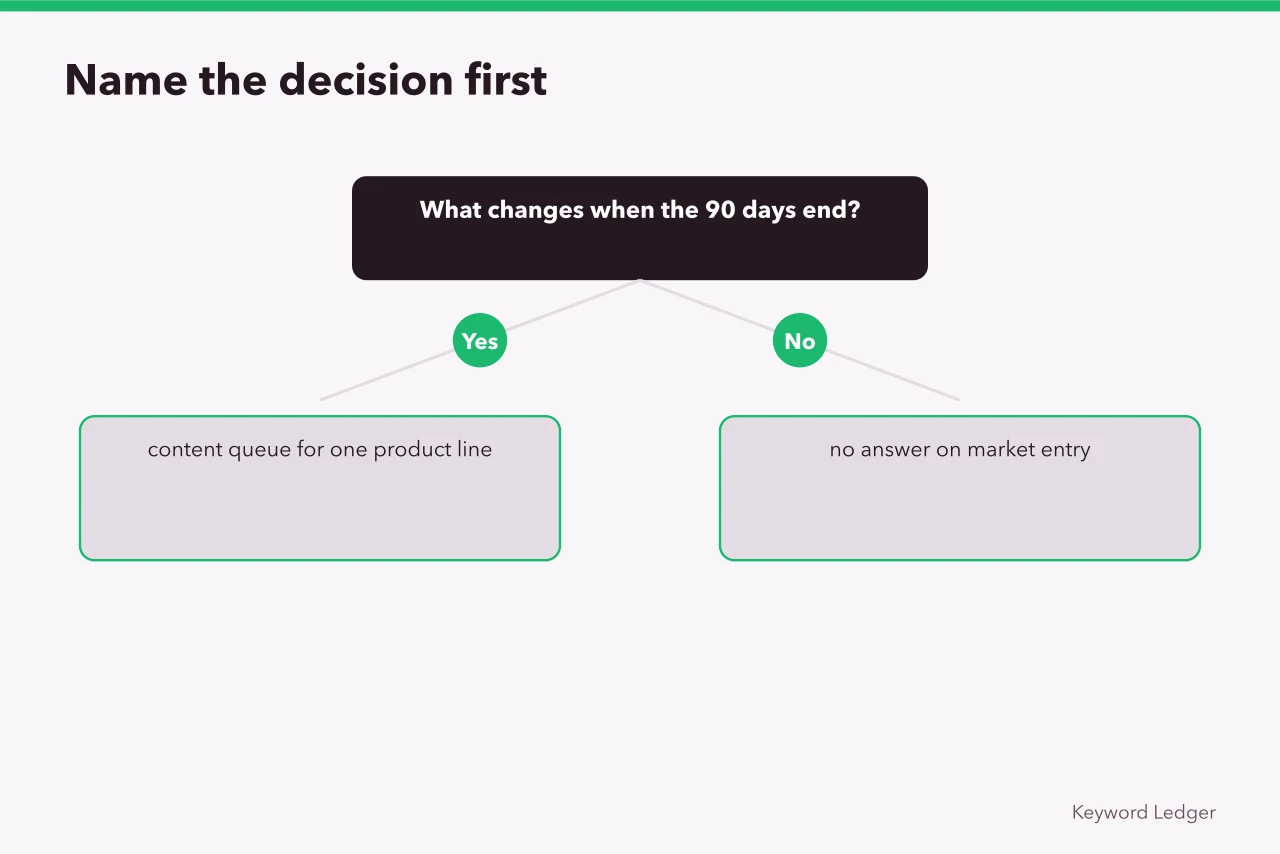
If you cannot name the decision, you cannot tell whether a keyword belongs in scope. The wider keyword research: strategy and planning guide for 2027 sets out the strategy layer this plan sits under.
How should you scope the first thirty days?
Weeks 1 to 3 are for boundaries and housekeeping. Agree the audiences and markets in scope, then decide which business units get a vote and who makes the final call. Audit what you hold already: Google Search Console queries, site search logs, sales call notes and support tickets.
First 30 days: scope and audit
- Agree audiences and markets in scope
- Decide which business units get a vote
- Name the final decision maker
- Audit console exports and agency reports
- Collect terms sales hears on calls
- Keep raw notes in a controlled folder
Anything that identifies a person is personal data under the UK GDPR, and the ICO's guidance on what counts as personal information explains the test. Keep raw notes in a controlled folder and store only what the plan needs.
What does the evidence phase look like?
Weeks 4 to 9 turn raw terms into a defensible picture. Group queries by intent and by the page type that could answer them. Record volume, difficulty and commercial value, noting the source and date for every figure so a later challenge has an answer.
Tool estimates disagree and seasonal peaks distort annual averages, so keep both sources and note why when they conflict. Common traps are catalogued in keyword research strategy mistakes in England, worth reading before you commit budget to a single data source.
UK regulatory context belongs here too. The ASA/CAP Code and CMA guidance govern advertising claims and comparisons in the UK. The FTC's reports on advertising and marketing policy show how enforcement thinking moves in the United States, which matters if your plan touches claims, comparisons or paid placement.
How do you map terms to pages and owners?
Mapping turns a list into a plan. For each cluster, name the page, format, owner and quarter it lands in. One cluster maps to one primary page; where two pages compete for the same cluster, fix the cannibalisation before publishing.
Worked example: a cluster of 14 queries around "commercial boiler servicing" shows a combined monthly volume of 1,300 and an average difficulty of 22 in a typical UK tool. It maps to /commercial-boiler-servicing, owned by the facilities content lead, and lands in Q1. The figures are illustrative; your own tool and market will set the real numbers.
Search visibility is a portfolio question rather than a single-channel one. Semrush's overview of building search visibility across channels is a reminder that organic pages, paid placements and profile results all shape what a buyer sees.
What should the final thirty days deliver?
Weeks 10 to 13 produce artefacts, not activity: a prioritised queue with owners and dates, a measurement note, and a stop list of terms you have excluded. The stop list is the most valuable page in the pack.
Sample queue template:
Final thirty days deliver
| Cluster | Page | Owner | Quarter | Status |
|---|---|---|---|---|
| commercial boiler servicing | /commercial-boiler-servicing | facilities content lead | Q1 | queued |
| boiler maintenance checklist | /boiler-maintenance-checklist | facilities content lead | Q1 | queued |
Sample stop list:
Final thirty days deliver
| Term | Reason excluded | Review date |
|---|---|---|
| free boiler grant | regulated claims, not our service | Q3 |
| boiler scrappage scheme | past campaign, low fit | Q3 |
Sign-off should be a short meeting with one decision. Either the queue is approved, or it returns with named changes. Book a review date roughly ninety days out, so the next cycle starts from evidence rather than memory.
What sequence should you follow?
- Name the decision the plan must settle and its accountable owner.
- Set scopeaudiences, markets, languages and excluded units.
- Audit existing data and agree storage rules for anything personal.
- Collect terms from tools, site search, sales calls and support tickets.
- Group terms by intent and by the page type that answers them.
- Record volume, difficulty, value, source and date for each cluster.
- Resolve conflicts between sources and document the choice you made.
- Map each cluster to one page and one quarter.
- Write the stop list and the measurement note.
- Get sign-off, publish the queue and book the review date.
Common questions
How many keywords should a ninety day plan cover?
Fewer than most teams expect. A typical capacity rule is four to six clusters per writer per quarter, with a reserve of two. Size the queue to the writers you have, not the list you can generate.
Do you need paid tools to run this plan?
No, but paid data shortens the evidence phase. Free sources, site search and sales notes can carry a small plan; if you buy a licence, note the renewal date so it does not surprise the budget holder.
What if the business changes priorities mid-plan?
Protect the scope phase and renegotiate the queue. Record what changed and why, so the next cycle learns from it.